
Anyone who has worked with real-time PCR knows the challenge: you design a robust assay, only to have the reaction fail because the sample contains PCR inhibitors. Whether those inhibitors come from blood, soil, plant tissues, or complex food matrices, they can dramatically reduce amplification efficiency—or stop the reaction altogether to lead to a false negative result.
Developing DNA polymerases that can overcome these inhibitors has traditionally been a slow and labor-intensive process. Conventional directed evolution workflows often require enzyme purification from thousands of mutant clones or specialized technologies such as emulsion PCR that needs expensive equipment, making the discovery of improved enzymes both time-consuming and expensive.
A study published in Frontiers in Bioengineering and Biotechnology introduces a simpler, faster approach. In "Live Culture-Based qPCR Screening of Taq DNA Polymerase Variants for Resistance to PCR Inhibitors," researchers Milko B. Kermekchiev, Zhian Zhang, and Wayne M. Barnes describe an innovative platform called Live Culture PCR (LC-PCR) that dramatically streamlines polymerase screening.
What Is Live Culture PCR (LC-PCR)?
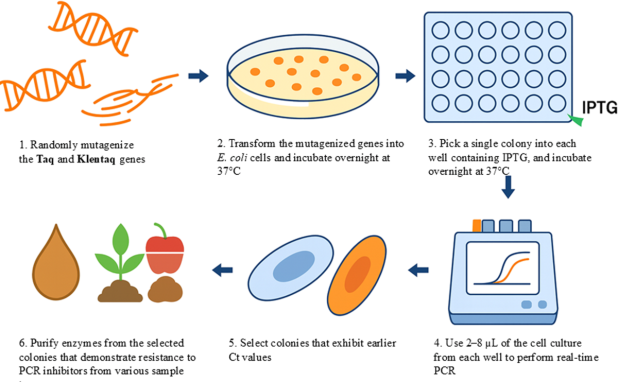
Rather than purifying enzymes or lysate of cells from thousands of bacterial cultures, LC-PCR uses intact, living bacterial cells directly in the PCR reaction. The bacteria express the mutant polymerase while simultaneously providing the DNA template, allowing researchers to evaluate enzyme performance in a single, streamlined assay.
Key advantages include:
- Dual-purpose bacterial cells: The host cells serve as both the source of the mutant polymerase and the PCR template.
- No sample preparation: Cell lysis, centrifugation, and enzyme purification are eliminated before screening.
- High-throughput workflow: Screening is performed in standard 96-well microplates, enabling thousands of variants to be evaluated rapidly using conventional real-time PCR instruments.
- Lower cost and greater accessibility: The method avoids specialized equipment such as emulsion PCR systems, making directed evolution practical for many more laboratories.
Discovering Next-Generation Polymerases
To demonstrate the power of LC-PCR, the researchers screened approximately 14,000 mutant clones under highly inhibitory PCR conditions using challenging food-derived inhibitors such as chocolate and black pepper.
The screening identified two exceptional polymerase variants:
- Taq C-66 (now commercialized as OmniTaq 3) — a full-length Taq DNA polymerase containing a single amino acid substitution within the palm subdomain that substantially improves resistance to PCR inhibitors.
- Klentaq1 H101 (now commercialized as Omni Klentaq 2) — an N-terminal deletion variant carrying a mutation near the fingers domain, likely enhancing interactions with DNA or incoming nucleotides during DNA synthesis.
Importantly, both enzymes retained their enhanced inhibitor resistance after purification, demonstrating that the improved performance resulted from intrinsic properties of the polymerases rather than effects from the host cells.
When challenged with difficult sample types—including whole blood (up to 40% of the reaction volume), humic acid, plant extracts, and complex food matrices—both variants consistently outperformed wild-type enzymes, other competing enzymes as well as our previously developed inhibitor-resistant mutants.
Why LC-PCR Matters
The significance of LC-PCR extends well beyond the discovery of two improved polymerases. The platform itself represents a powerful new strategy for enzyme engineering.
Because screening conditions can be readily modified, LC-PCR can be adapted to evolve polymerases for a wide range of desirable characteristics, including:
- Increased resistance to PCR inhibitors
- Faster DNA synthesis, with some variants achieving extension rates approaching 1 kb per second
- Higher amplification fidelity
- Enhanced reverse transcriptase activity for both RNA and DNA templates
By eliminating labor-intensive preparation steps while maintaining high-throughput capability, LC-PCR makes directed evolution faster, more economical, and accessible to virtually any molecular biology laboratory equipped with a standard real-time PCR instrument.
As direct PCR and sample-to-answer diagnostics continue to gain momentum, technologies like LC-PCR are poised to accelerate the development of faster, more robust molecular diagnostics to clinical, environmental, food safety, and research applications.