
The Polymerase Chain Reaction (PCR) has transformed molecular biology, enabling applications ranging from basic research to clinical diagnostics and food safety testing. Yet for many years, researchers faced persistent challenges with conventional Taq DNA polymerase, including limited amplification of long targets, susceptibility to PCR inhibitors, and suboptimal fidelity.
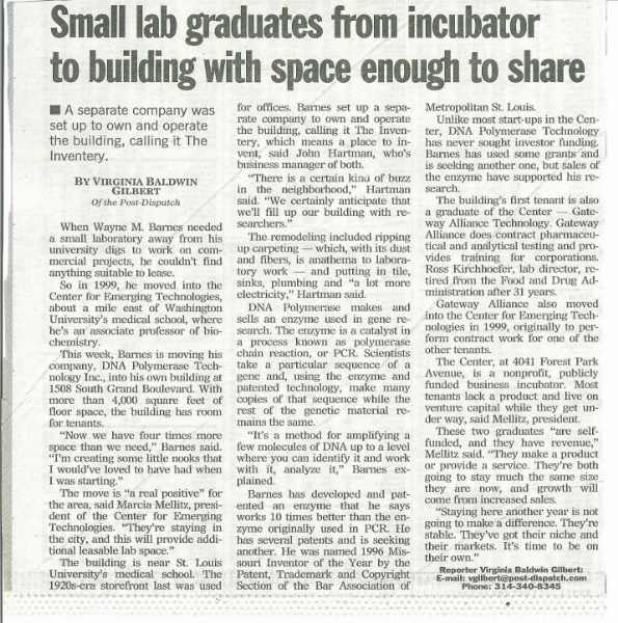
These challenges inspired the founding of DNA Polymerase Technology, Inc., a company dedicated to engineering innovative DNA polymerases that make PCR faster, more robust, and more reliable.
The Invention of Klentaq: Improving a Classic Enzyme
The story began in 2002 at Washington University in St. Louis, where Dr. Wayne M. Barnes sought to overcome several limitations of wild-type Taq DNA polymerase.
By removing the N-terminal 5′→3′ exonuclease domain, Dr. Barnes created Klentaq1 (Klentaq), a truncated form of Taq polymerase that retained excellent PCR activity while offering several important advantages:
- Higher fidelity than wild-type Taq polymerase
- Improved thermostability during repeated thermal cycling
- Cleaner amplification resulting from the absence of 5′→3′ exonuclease activity
Klentaq quickly became a valuable tool for applications requiring reliable and highly specific PCR amplification.
Breaking the Long-PCR Barrier: Klentaq LA
Dr. Barnes next addressed another major challenge in PCR—the amplification of long DNA fragments.
By combining Klentaq with a small amount of a proofreading DNA polymerase possessing 3′→5′ exonuclease activity, he developed Klentaq LA (Long & Accurate). This optimized enzyme blend enabled reliable amplification of genomic DNA fragments exceeding 35 kb while maintaining high fidelity.
Klentaq LA significantly expanded the capabilities of PCR for applications including genome analysis, gene cloning, and sequencing.
To make these technologies broadly available to the scientific community, Dr. Barnes founded DNA Polymerase Technology, Inc.
Engineering Polymerases for Direct PCR
As PCR applications expanded into clinical diagnostics, forensic science, environmental testing, and food safety, PCR inhibition became an increasingly important challenge. Biological and environmental samples often contain compounds such as hemoglobin, humic acid, melanin, plant polysaccharides, and food-derived inhibitors that interfere with DNA amplification and necessitate labor-intensive nucleic acid purification.
Using directed evolution and rational protein engineering, DNA Polymerase Technology developed a series of polymerases designed to tolerate these challenging sample types.
OmniTaq and Omni Klentaq were engineered for direct PCR from inhibitor-rich samples, supporting amplification from whole blood (treated with EDTA, citrate, or heparin), serum, plasma, soil, plant tissues, feces, urine, food matrices, and other complex specimens.
To further improve assay performance, the company developed several complementary technologies or reagents:
- Cesium Hot-Start Polymerases – Automatic hot-start enzymes that minimize nonspecific amplification and primer-dimer formation.
- ZipTaq DNA Polymerase – An ultra-fast polymerase capable of extension rates approaching 1 kb per second, substantially reducing PCR cycling times.
- PCR Enhancement Cocktails (PECs) – Proprietary enhancer formulations that improve amplification efficiency and inhibitor tolerance for both DNA Polymerase Technology enzymes and many commercial Taq polymerases.
- Flex T7 RNA Polymerase – An engineered T7 RNA polymerase that efficiently incorporates ribonucleotides, deoxyribonucleotides, and modified nucleotides, including 2′-fluoro nucleotides, while maintaining promoter specificity. The enzyme enables efficient synthesis of chemically modified, nuclease-resistant RNA transcripts and offers improved thermostability compared with conventional T7 RNA polymerases.
Continuing to Advance PCR Technology
Today, DNA Polymerase Technology continues to develop specialized PCR reagents, including inhibitor-resistant polymerases, hot-start formulations, lyophilization-compatible format, and high-performance reagents for direct PCR and RT-PCR applications.
From its origins in a university research laboratory to becoming a global supplier of advanced PCR enzymes, the company's mission has remained the same: to develop innovative polymerases that simplify molecular workflows, improve assay robustness, and enable reliable nucleic acid amplification from even the most challenging samples.